ATOMKI-QUEENS UNIVERSITY ICE CHAMBER FOR LABORATORY ASTROCHEMISTRY (AQUILA)
Background
In collaboration with Queen’s University of Belfast and the University of Kent, a facility for ion irradiation studies of astrophysical ice analogues has been established at the ECR Ion Source (ECRIS) Laboratory at Atomki, Debrecen. AQUILA (Atomki-Queen’s University Ice Chamber for Laboratory Astrochemistry) is part of the Europlanet Research Infrastructure and has been operational since 2022. It provides transnational access (TA) measurements, extending the capabilities of the ATOMKI Accelerator Centre in the field of laboratory astrophysics and astrochemistry. The experimental apparatus aims to systematically study space-relevant ices under different ion impacts, mimicking the effect of the solar wind, to gain a better understanding of the origin and evolution of the building blocks of life.
Key Features of the AQUILA Setup
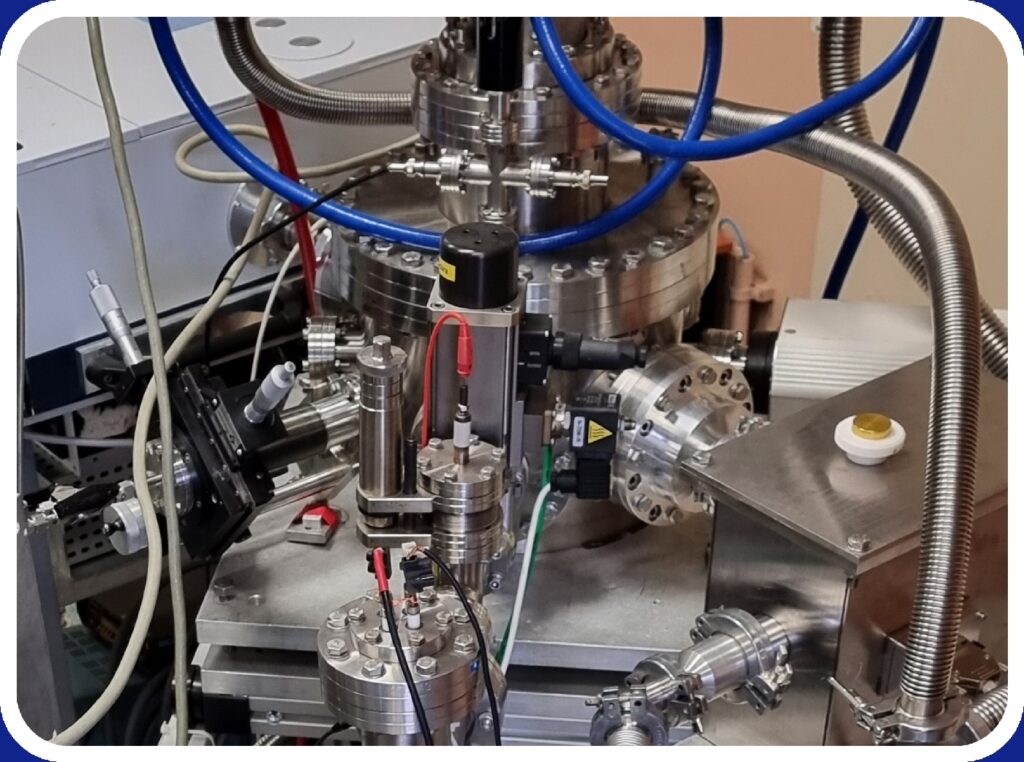
Ion source: 14 GHz room temperature ECRIS, Energy 0.5 – 30 Q*keV
AQUILA Chamber: Bakeable, base pressure 5xE-9 mbar
Cold head: Sumitomo 10 K, sample holder for 1 substrate (diameter – 15 mm), XY-plane rotary stage
Sample deposition: Both direct and background
Infrared Spectrometer: FTIR Bruker v70, Detectors – MCT & DLaTGS
QMS: Detector – FC and SEM, mass range 1-250 amu
Introduction of the AQUILA Setup
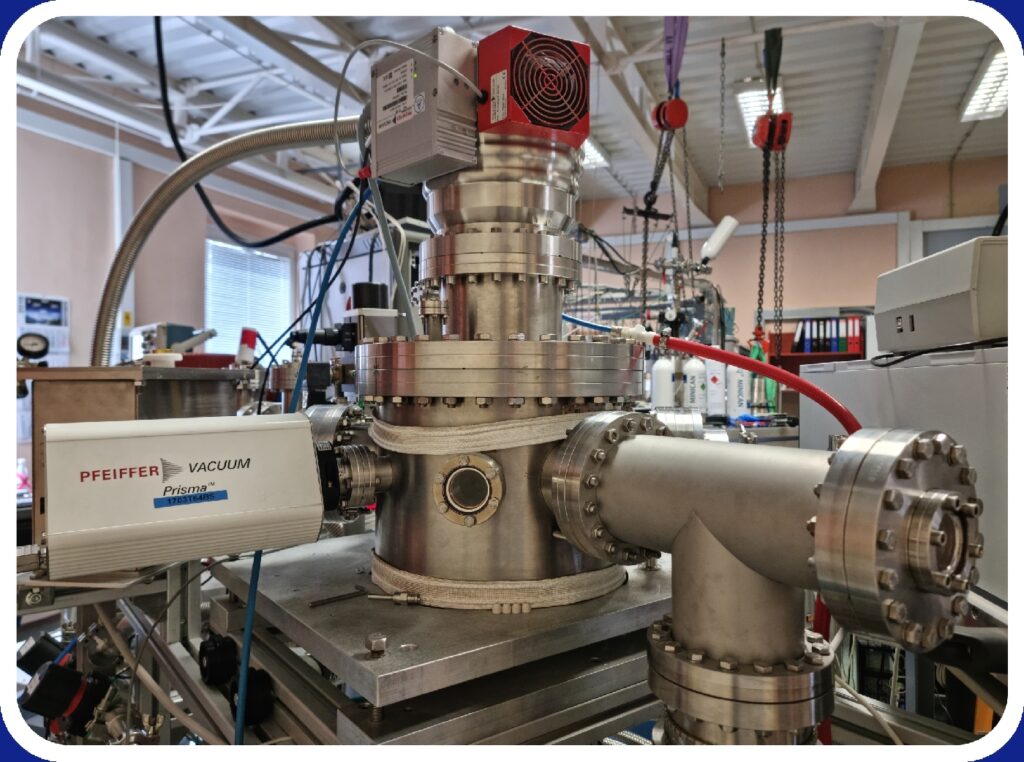
AQUILA features an UHV-compatible chamber containing a substrate on which astrophysical ice analogues can be grown at cryogenic temperatures (≥20K). These ices can be processed through ion irradiation provided by the ECR Ion Source at Atomki. The ECRIS can generate nearly all known components of the solar wind, including H, He, C, O, Si, Fe, and Ni. Additionally, ECRIS can produce highly charged ions, such as fully stripped Ne ions. It is also capable of generating certain negative ions and molecular ions as well as positive molecular ions. The available energy range extends from a few hundred eV to several tens of keV, making this setup ideal for studying the physics and chemistry of solar wind radiation.
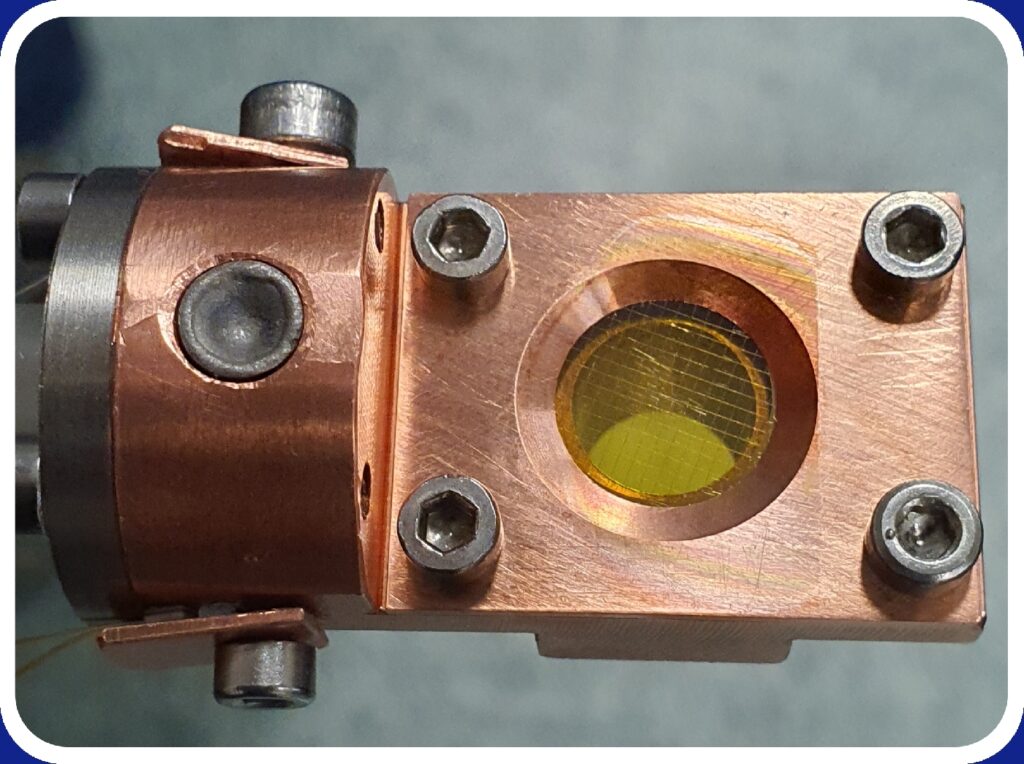
Ice films composed of either pure gases or gas mixtures can be deposited onto a cold ZnSe substrate. The substrate holder allows for full 360° rotation around its axis. Deposition can be performed using both background and direct methods for both pure gases and gas mixtures. Thickness measurement of the deposited ice films by laser interference method is also available.
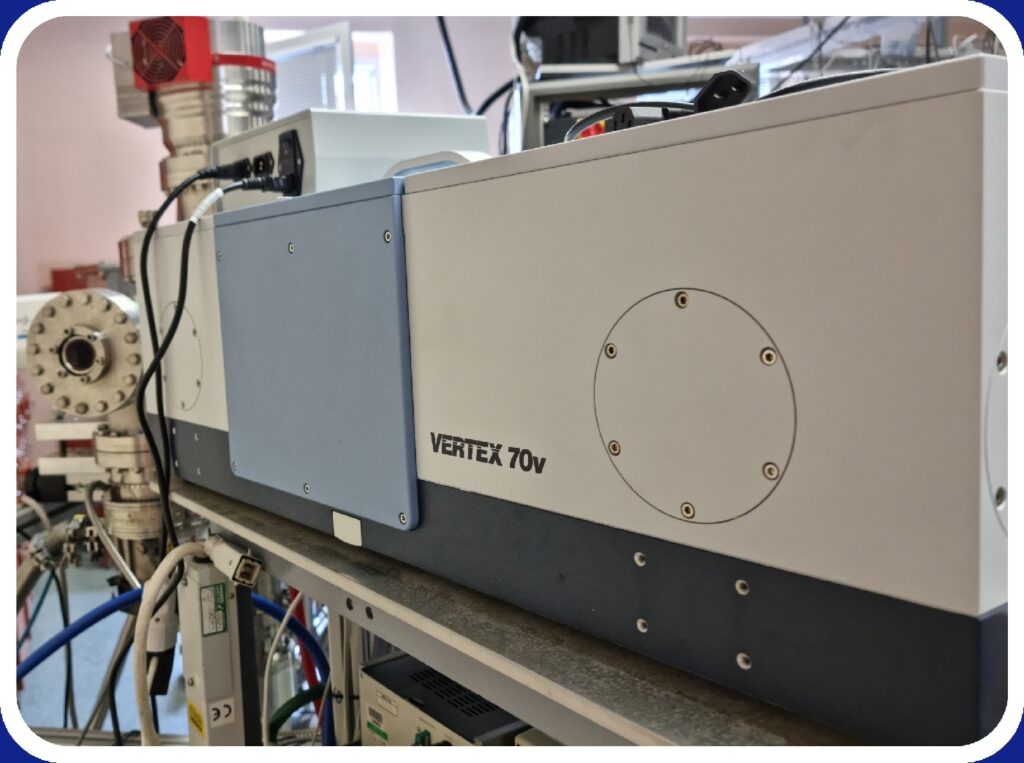
The resulting physicochemical changes in the ice layers due to irradiation are monitored by infrared spectroscopy in either transmission or reflection mode by a Bruker Vertex 70V spectrometer operating in the MIR spectral range. Optionally, the setup can be equipped with a QMS spectrometer in order to analyze the sputtered fragments (mass range: 1–300 amu) ejected from the ice during ion irradiation. Temperature-programmed desorption (TPD) studies can also be performed on both non-irradiated and irradiated ices in order to identify molecules desorbing from the ice layer.
If you would like to learn more about the AQUILA setup, please refer to the following publication: